AI API Mapper
/ platform · architecture & capabilities

Turn enterprise APIs
into governed AI tools

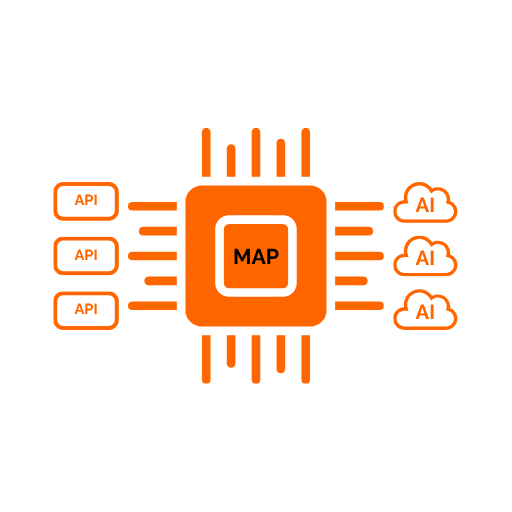
AI API Mapper sits between the APIs you already run and the AI agents that want to call them — governing identity, access, and audit on every request across REST, SOAP, OData/Microsoft Graph, SQL stored procedures and remote MCP servers.

v1.3.18Tenant-awareMCP 2025-11-25 · 2026-07-28
  runtime · trace 7f3c…91b2tools/call
01AI client MCP requestJWT
↓
02Runtime authorizes against policydefault-deny
↓
03Resolve credentials · transform inputkey vault
↓
04Invoke REST, SOAP, SQL or MCP downstreamallow-list
↓
05Transform output · record audittrace
The Gap

AI clients can't safely call the APIs
you already built

Downstream APIs were designed for web, mobile, or system-to-system integrations. AI tools need clear names, typed inputs, predictable outputs, and a controlled execution boundary — and someone needs to know who called what, under which tenant, with which credentials.

10+
Downstream auth strategies
3
Schema discovery modes
4
Executable hosts
2026-07-28
Newest MCP revision, served beside 2025-11-25
Architecture

Four hosts, one governed product

The platform is a modular monolith with separate executable hosts for administration, runtime execution, background processing, and edge routing — backed by a shared persistence model.

/ 01

Portal

Admins · Operators

REST admin API plus a web app for human administrators. Onboarding, mapping authoring, toolset and client-app management, identity, governance dashboards, audit review.

  • API onboarding
  • Mapping lifecycle
  • MCP toolsets
  • Governance dashboards
/ 02

Runtime

AI clients · Copilots

The AI-facing execution surface. Presents a per-tenant tool catalog, authorizes callers, resolves credentials, transforms requests and responses, records audits.

  • MCP JSON-RPC 2.0
  • REST · SOAP · SQL · MCP execution
  • Hosted Agent runs
  • Configuration snapshots
  • Call-trace by correlation
/ 03

Jobs Worker

Async workloads

Background processing for semantic enrichment, AISI document indexing, hosted-agent schedules, governance audit, and scheduled retention. Message-driven execution, retry handling, and scheduled maintenance are kept outside the request path, and the worker runs as several replicas — with AISI on workers of its own if you choose.

  • Semantic enrichment
  • AISI indexing
  • Agent schedules
  • Scales to several replicas
  • Retention windows
/ 04

Gateway

Network edge

Reverse-proxy entry point in front of all internal hosts. Enforces per-route authentication requirements and lightweight JWT structural validation before proxying. Strips untrusted forwarding and hop-by-hop headers, applies per-identity edge rate limiting by traffic category, and centralizes browser security, request correlation, and ingress observability.

  • Reverse proxy
  • JWT precheck
  • Header hardening
  • Edge rate limiting
  • Health & metrics
Capabilities

From onboarding to audited execution —
end to end

Nine functional areas, owned by one platform, configured by humans in the Portal and enforced by the Runtime on every call.

C-01
Onboard any API contract
Import API definitions from a URL or raw document — OpenAPI, SOAP/WSDL, or OData v4 (CSDL), including Microsoft Graph — the stored procedures of a SQL Server, PostgreSQL, MySQL / MariaDB or Oracle database, or the tools of another MCP server, reviewed tool by tool and watched for changes afterwards. CSDL is parsed into a canonical semantic model before translation, so entity sets, navigation, actions/functions, and capability restrictions (InsertRestrictions/UpdateRestrictions/DeleteRestrictions) survive rather than being flattened. Every protocol shares the same preview/curation workflow — allow/deny lists, tag/path filters, and a mandatory explicit-selection step for oversized contracts.
OpenAPI importSOAP/WSDL importOData/CSDL importMicrosoft Graph dialectSQL stored proceduresRemote MCP serversTool drift detectionPreview & curate
C-02
Author the mapping lifecycle
Mappings carry the contract boundary: ExposedFieldName for AI callers, SourceFieldName for the downstream request. Draft, version, approve, publish, deprecate, revert, restore. When the source API belongs to a versioned family, new mapping drafts can be seeded from a specific API revision — preserving endpoint IDs where operations match so toolset selections survive an API update. Each endpoint can also carry behavioral annotation hints (read-only, destructive, idempotent, open-world) for MCP clients.
Exposed ↔ Source fieldsVersioningAPI version targetingAnnotation hintsREST + SOAPApprovalPublishRestore
C-03
Enrich with AI assistance
Chunked LLM pipeline generates names, descriptions, field suggestions, and endpoint behavioral annotation hints as a proposal alongside the draft — never overwriting it. Accept per field, per endpoint, or whole. Cancel mid-run. Every chunk is traced with prompt, raw output, and token counts. Attach up to 5 reference documents (.txt, .md, .pdf) to give the LLM extra context beyond the imported contract — scanned for prompt injection before processing, with extracted text and content hashes recorded on the run. Configure OpenAI-compatible, Azure OpenAI or Claude connections — the Claude API, Amazon Bedrock, Google Cloud Vertex AI or Microsoft Foundry — with named model profiles carrying reasoning effort, advanced parameters, input modalities and prices, each testable from the Portal. Limit a connection to the features allowed to use it, set default models per tenant and per feature, or pick a specific model profile for each enrichment run. The LLM Usage Dashboard shows what every connection spent, per application, model and feature.
Proposal reviewGranular acceptAnnotation hint inferenceReference attachmentsCancellable runsPer-chunk traceabilityOpenAI · Azure OpenAI · ClaudePer-feature model defaultsLLM usage & cost dashboard
C-04
Publish to MCP toolsets
Bundle endpoints into toolsets, assign to tenant-scoped client apps, manage API keys. Pick the schema discovery mode (Full · Data-Structure-Only · Lazy) per toolset, override per endpoint. Compose system prompts across three layers — toolset, client, and assignment (append or override). Serve tools over MCP JSON-RPC or Server-Sent Events, whichever transport your client expects, to clients on MCP 2025-11-25 and 2026-07-28 alike — with your API's validation rules (allowed values, patterns, ranges) carried into every tool schema.
MCP toolsetsSchema discovery modesValidation rules in schemasPrompt compositionClient appsAPI keysSSE transport
C-05
Bind downstream credentials
Target systems, target authentication profiles, tool endpoint authentication bindings, credential workflow definitions, outbound host allow-lists, managed secret storage, and secret store connections all come together in one security surface. Delegated On-Behalf-Of token exchange lets a downstream call run as the signed-in user instead of a shared service identity — Microsoft Graph via Entra ID is the first supported provider — and OAuth authorization code connects a remote MCP server once for everyone, or per user with each person's own consent. A secret can be limited to the features allowed to use it. Outbound calls can go through HTTP, HTTPS or SOCKS5 forward proxies with Basic or NTLM / Kerberos authentication, chosen per connection and enforced platform-wide; a call to an unavailable proxy fails closed, and every trace shows the route it took.
Passthrough bearerAPI keyBasic authSOAP UsernameTokenSOAP headersWorkflowsOn-Behalf-Of (OBO)OAuth authorization codeDatabase loginsSecret allowed usagesForward proxies
C-06
Govern at the runtime edge
Default-deny tool authorization. Per-tool policies on issuer, client ID, roles, scopes, groups, custom claims. Configurable audit filters. Opt-in sanitized request/response capture and per-step call trace timing across REST and SOAP executions. Every governance event can be fanned out durably to external compliance sinks — REST endpoints, syslog receivers, SQL Server tables, or PostgreSQL tables — with retry, worker leasing, and per-target health monitoring.
Default-denyPer-tool policySanitized captureREST + SOAP tracesAudit filtersExternal audit fan-out
C-07
Retrieve from your own databases with ESRA
ESRA — the Enterprise Semantic Retrieval Agent — lets an AI client ask a question in plain language and get back governed evidence from your enterprise databases. No vector database, no embedding pipeline, and no copy of your data unless you ask for one: retrieval runs on the native full-text engine of the database itself. Sources are modeled in business terms, a service LLM picks the relevant ones and plans several search strategies each — precise, intermediate and broad — and every query executes as a parameterized full-text query against a read-only principal: the model produces structured intent, never SQL. Record filters built from the caller's claims are applied in the query, not after it. Filter fields can list the values they hold, so callers and the planner name values the data actually contains, and each stage that calls a model — source selection, planning, reranking, answer — can use a model of its own; selection and reranking can run on a decision model that answers with probabilities instead of text. Included on every plan.
Six full-text enginesNo vectors, no embeddingsRead-only principalsRecord-level filtersAllowed filter valuesA model per stageDecision modelsIndexed by AISIPublished as an MCP tool
Learn more about ESRA →
C-08
Index your file storage with AISI
AISI — the AI Storage Indexer — keeps the documents in SFTP and FTPS servers, OneDrive and SharePoint, Google Drive and S3-compatible buckets indexed in a database or search cluster you already run, so ESRA can search them. Nothing is uploaded: documents stay where they are, and every result links back to the original. Files are extracted to Markdown, scanned pages are read by OCR, and an index can hold the full text, a model-written summary, or both. Changes are picked up on a schedule or, where the storage can notify, within seconds. AISI provisions the index itself or hands a DBA the script, and never drops anything in your database. Included on every plan.
SFTP · FTPSOneDrive · SharePointGoogle DriveS3-compatibleOCRSummariesSix destination enginesNo upload
Learn more about AISI →
C-09
Talk agent-to-agent with A2A
A2A (Agent2Agent) is the platform's second AI-facing protocol, alongside MCP: the same governed tool catalog, reshaped as an Agent Card of callable skills. A registered agent is either a concentrator — a governed proxy to a real remote peer, reusing the platform's own downstream credential brokering rather than holding the remote agent's credentials anywhere else — or a Hosted Agent: an LLM-backed reasoning agent, built on Microsoft Agent Framework, that runs admin-defined Skills over a curated subset of your MCP toolsets and knowledge-base tools. A Hosted Agent skill can recognize an incomplete request and ask a clarifying question instead of failing outright, then resume the same conversation on the caller's follow-up — every tool it calls still goes through the exact same authorization, credential resolution, and audit pipeline a deterministic call uses. Hosted Agents also start without a caller — on a schedule, from a signed webhook, or on demand through the Runtime API — acting as a governed run identity, and can ask other hosted or remote agents for help on behalf of the original caller. Every run has its own page, readable as a conversation.
Agent Card discoveryConcentrator (proxy) modeHosted Agent (LLM-backed) modeSchedules · webhooks · on demandRun identitiesAgent delegationRun pages & transcriptsStructural prompt-injection defense
Learn more about A2A →
Under the hood

The four contracts
that make this work

Most of the platform's value lives in four small but specific contracts. They are the ones your engineers will ask about first.

/ Field contract

Exposed ↔ Source

Mappings split what an AI caller sees from what the downstream service receives. ExposedFieldName is the MCP-visible business vocabulary; SourceFieldName is the downstream path the runtime translates to on the way out and back. Structural markers (nested objects, [*] array positions) survive round-trip.

{
  "ExposedFieldName": "customerEmail",
  "SourceFieldName":  "data.party[*].contacts.email"
}
/ MCP schema modes

Three discovery modes

Per toolset (overridable per endpoint): Full sends the complete schema with descriptions; Data-Structure-Only keeps the shape but drops descriptions to cut tokens; Lazy returns only a discovery placeholder. When Lazy or DSO is in play, the runtime injects a discover_tool_schema meta-tool that returns the authoritative inputSchema, outputSchema, version and hash.

tools/list  →  inputSchema: {
  "_schema_discovery": "use discover_tool_schema"
}
/ Prompt composition

Three layers, one prompt

The effective MCP system prompt is composed from the toolset default, the client application prompt (when the assignment opts in), and an optional assignment-specific prompt set to either Append or Override. The same toolset can therefore present different effective prompts to different client applications inside the same tenant.

effective_prompt =
  toolset.default
  + (client.prompt if opt_in)
  + (assignment.custom : append | override)
/ Sanitized capture

Audit you can show auditors

Request/response logging is opt-in at toolset level with per-endpoint overrides. Captured MCP and downstream HTTP payloads are sanitized: Authorization, token, api_key, secret, password, cookie names are redacted in headers, JSON properties, and query strings. Content past 512KB (configurable) is truncated with a marker.

Authorization: Bearer [redacted]
{ "api_key": "[redacted]", ... }
?secret=[redacted]&limit=20
Client SDKs

Three method calls,
no MCP plumbing

Native client libraries in .NET, TypeScript, Python, and Java expose the same conceptual interface — get the system prompt, get the tools, invoke a tool — with session management, credential injection, and MCP pagination handled internally. Orchestrator adapters convert the tool list into the native format expected by Microsoft.Extensions.AI, Semantic Kernel, Azure AI Foundry Agents, OpenAI, LangChain, LangGraph, and Spring AI.

/ 01

.NET

dotnet add package

CodedProjects.AI.ApiMapper.Client

  • Get system prompt
  • Get tools (paginated)
  • Invoke tool
/ 02

TypeScript

npm install

@codedprojects/api-mapper-client

  • Get system prompt
  • Get tools (paginated)
  • Invoke tool
/ 03

Python

pip install

api-mapper-client

  • Get system prompt
  • Get tools (paginated)
  • Invoke tool
/ 04

Java

Maven / Gradle

com.codedprojects:api-mapper-client

  • Get system prompt
  • Get tools (paginated)
  • Invoke tool
Technical evaluation

What technical buyers usually
need to verify first

This is not a brochure-first product. The fastest evaluation path is to inspect the architecture, the runtime contract model, and the governance surface in that order.

/ Architecture proof

Review the host model and execution boundaries

Start from the platform and runtime specifications to verify how Portal, Runtime, Gateway, and Jobs Worker divide responsibilities, trust boundaries, and operational ownership.

Open architecture docs
/ Contract proof

Inspect the mapping and MCP contract model

Validate how exposed fields, source fields, schema discovery, prompt composition, and tool publication work before you invest time in a pilot.

Open Runtime spec
/ Governance proof

Check the audit, policy, and traceability model

Confirm how default-deny authorization, sanitized logging, claim checks, and correlation-level trace data behave in a governed production environment.

Open governance docs
/ Deployment fit

Understand the hosting and licensing model

Review how the platform is deployed inside customer infrastructure, how Runtime nodes are counted, and how the commercial model scales with real production footprints.

Open pricing
Inside the Platform

A closer look at the
platform in use

Screens from a running installation: tools reviewed before they go live, calls traced step by step, data and documents made searchable, hosted agents' runs explained, and what every model call cost

Main Functional Flow

Eight steps, one contract

From OpenAPI or WSDL on disk to a governed, tenant-scoped tool answered by your downstream service — with every hop visible to your operators.

01
Onboard

An administrator imports an OpenAPI, SOAP/WSDL or OData document, a database's stored procedures, or an MCP server's tools into the Portal.

02
Map

The platform creates a mapping proposal turning selected operations into business-friendly tool definitions.

03
Review

Administrators review, edit, approve, version, and publish the mapping.

04
Group

Published mappings are grouped into a toolset and assigned to one or more client applications.

05
Secure

Configure downstream connectivity, authentication strategies, secret sources, and runtime access policies.

06
List

An AI client calls the Runtime to list available tools for a tenant and client application.

07
Invoke

Runtime authorizes the caller, resolves credentials, transforms the request, and calls the downstream REST or SOAP API, stored procedure or MCP server.

08
Audit

Background jobs handle asynchronous work; every call lands as audit + call-trace data, fanned out durably to external compliance targets (REST, syslog, SQL Server, PostgreSQL).

Integrations

Speaks the enterprise stack
you already standardized on

First-class support for Entra ID, Keycloak, and Azure Key Vault. Open standards for trust, transport, and tool exposure. Designed to fit into enterprise identity, messaging, and deployment environments.

Microsoft Entra ID
/ identity · Portal SSO · trust
Keycloak
/ identity · Portal SSO · trust
Azure Key Vault
/ secrets · Managed secrets
OpenAI / compatible
/ ai · LLM connections
Azure OpenAI
/ ai · LLM connections
Anthropic Claude API
/ ai · LLM connections
Amazon Bedrock · Google Vertex AI · Microsoft Foundry
/ ai · Claude on cloud platforms
OpenAPI
/ ingest · Contract import
SOAP / WSDL
/ ingest · Contract import
OData v4 / CSDL
/ ingest · Contract import
Microsoft Graph
/ ingest · OData dialect
SQL stored procedures
/ ingest · SQL Server · PostgreSQL · MySQL · Oracle
Remote MCP servers
/ ingest · Tool import & calls
MCP 2025-11-25 · 2026-07-28
/ runtime · Tools / resources
MCP SSE transport
/ runtime · Streamed tool calls
A2A (Agent2Agent) 1.0
/ runtime · Agent-to-agent protocol
Microsoft Agent Framework
/ ai · LLM-backed Hosted Agent skills
OIDC + JWT
/ identity · Runtime trust
On-Behalf-Of (OBO)
/ identity · Delegated downstream auth
MassTransit
/ jobs · Background bus
RabbitMQ
/ jobs · Broker transport
Quartz
/ jobs · Scheduled work
SignalR
/ portal · Portal real-time
SharePoint · OneDrive
/ storage · Document indexing
Google Drive
/ storage · Document indexing
Amazon S3 / S3-compatible
/ storage · Document indexing
SFTP · FTPS
/ storage · Document indexing
SQL Server
/ data · Platform database
PostgreSQL
/ data · Platform database
HTTP downstream
/ runtime · Outbound execution
HTTP · HTTPS · SOCKS5 proxies
/ edge · Basic · NTLM · Kerberos
GitHub · Jira Cloud
/ runtime · Webhook presets for agents
SOAP downstream
/ runtime · Envelope execution
Reverse proxy
/ edge · Gateway routing
.NET / TypeScript / Python / Java SDKs
/ sdk · Client integration
Semantic Kernel · LangChain · LangGraph
/ sdk · Orchestrator adapters
Governance

Designed for the people who have to answer for it

Three layers of governance — runtime access, execution, and security — so AI tool exposure stays inside your existing controls.

Runtime access

Default-deny authorization

  • Allowed token issuer
  • Allowed client IDs
  • Roles, scopes, groups
  • Custom claim requirements
  • Tenant-aware evaluation
  • Device Authorization Grant (RFC 8628) for agents & CLIs
  • Browser OAuth Authorization Code + PKCE via Portal login
Execution

Audited, traceable calls

  • Audit records for runtime activity
  • External fan-out to REST, syslog, SQL Server, PostgreSQL
  • End-to-end trace by correlation ID
  • Per-toolset correlation propagation policy to downstream calls
  • Request / response visibility
  • Enrichment log monitoring
  • Validation outcome capture
  • Hosted-agent run pages, transcripts on request
  • Outbound route on every record
Security

Hardening across the surface

  • Outbound host allow-lists
  • Gateway edge JWT precheck + rate limiting
  • Trusted IdP administration
  • Secrets limited to their allowed usages
  • Forward proxies, enforced and failing closed
  • Delegated On-Behalf-Of downstream token exchange
  • Retention policies
  • Immediate session revocation, everywhere
  • Auto-revoke on refresh-token replay
Get started

Ready to expose APIs
to agents safely?

We'll walk through your environment, your downstream auth shapes, your expected Runtime footprint, and what a realistic first rollout would look like.
Request a technical walkthrough →Read the docs