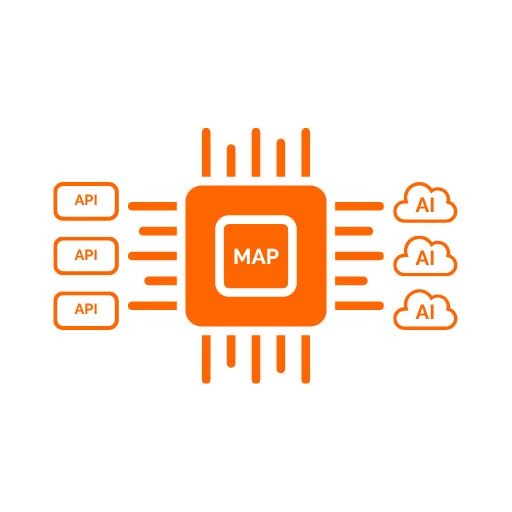
AI API Mapper Platform Overview
Purpose
The AI API Mapper Platform is a tenant-aware application that turns existing enterprise HTTP APIs into governed tools that AI agents and copilots can safely discover and invoke.
From a functional standpoint, the platform sits between:
- business APIs that were originally designed for web, mobile, or system-to-system integrations
- AI clients that need stable tool definitions, structured inputs, secure credentials, and auditable execution
Instead of exposing raw downstream APIs directly to AI callers, the platform adds onboarding, mapping, publication, runtime execution, identity, governance, and operational control.
Which Problem It Solves
The platform addresses a common enterprise gap:
- downstream APIs often expose technical operations, inconsistent payloads, and authentication schemes that are difficult for AI clients to use directly
- AI tools need clear names, typed inputs, predictable outputs, and a controlled execution boundary
- organizations need to know who invoked what, under which tenant, with which credentials, and whether the call complied with policy
The platform resolves this by letting administrators:
- import API definitions from OpenAPI and SOAP/WSDL contracts
- inspect protocol-aware operation metadata, request/response schemas, SOAP headers, and fault shapes after import
- define and refine functional mappings for selected operations
- publish those mappings as AI-facing tools
- bind tools to downstream target systems and authentication profiles
- enforce access policies and runtime governance
- observe runtime activity, enrichment activity, and platform security events
Main Functional Flow
At a high level, the application works like this:
- An administrator uses the Portal to onboard an API from an OpenAPI or SOAP/WSDL document.
- The platform creates a mapping proposal that turns selected API operations into business-friendly tool definitions.
- Administrators review, edit, approve, version, and publish the mapping.
- The published mapping is grouped into a toolset and assigned to one or more client applications.
- Administrators configure downstream connectivity, authentication strategies, secret sources, and runtime access policies.
- An AI client calls the Runtime to list available tools or invoke a specific tool for a tenant and client application.
- The Runtime authorizes the caller, resolves credentials, transforms the request, calls the downstream API, transforms the response, and writes audit data.
- Background jobs process asynchronous work such as semantic enrichment and data retention.
Platform Architecture
The platform is implemented as a modular monolith with separate executable hosts for administration, runtime execution, background processing, and gateway routing.
The main building blocks are:
- business modules for onboarding, mapping, runtime, governance, identity, downstream security, tenants, jobs, secrets, and notifications
- a shared persistence model backed by a platform database
- a dedicated runtime surface for AI callers
- a dedicated portal surface for human administrators
- background workers for asynchronous processing and scheduled maintenance
- a reverse proxy entry point
Main Components
The platform is organized around five main platform components:
- Portal Handles administration, configuration, governance monitoring, identity management, and the operator web experience.
- Runtime Exposes published tools to AI clients and executes governed downstream calls.
- Jobs Worker Runs asynchronous and scheduled workloads such as semantic enrichment and data retention.
- Gateway Provides the reverse-proxy entry point in front of the externally exposed portal and runtime services.
- SDK Client libraries for .NET, TypeScript, Python, and Java that integrate with the Runtime without writing any MCP or HTTP plumbing.
Supported Databases
The Portal, Runtime, and Jobs Worker use the same shared platform database and platform data model.
Supported Integrations
The platform currently includes first-class functional support for:
- Microsoft Entra ID Used for external portal sign-in and related claim mapping, tenant-aware provider configuration, and user linking/provisioning flows.
- Keycloak Used for external portal sign-in using the OIDC Authorization Code + PKCE flow, with the same claim mapping and tenant-aware provider configuration available for Microsoft Entra ID.
- Azure Key Vault Used as a supported managed secret store for runtime and administrative secret resolution.
The platform also supports related integration patterns such as:
- OpenAPI and SOAP/WSDL import for onboarding downstream APIs
- OIDC and JWT-based trust for runtime callers
- HTTP and SOAP downstream invocation
- SignalR notifications in the portal
- Message-driven background processing with configurable transport options
Governance Supported
The platform provides governance in several layers.
Runtime access governance includes:
- default-deny tool authorization when no active policy matches
- per-tool access policies based on issuer, client ID, roles, scopes, groups, and custom claim requirements
- tenant-aware policy evaluation
Execution governance includes:
- audit records for runtime activity
- durable external audit delivery through compliance or operational targets
- end-to-end call trace inspection by correlation ID with per-step timing
- configurable audit event filtering by category, action, and outcome
- opt-in request and response payload capture for MCP and downstream traffic with automatic sanitization and truncation
- enrichment run monitoring for AI-assisted mapping generation, including per-chunk LLM traceability and token usage
External audit delivery supports deployment-managed compliance sinks and UI-managed operational sinks. Compliance targets can fan out to HTTPS REST endpoints, TLS syslog receivers, SQL Server tables, or PostgreSQL tables, while the platform persists the canonical audit event and append-only delivery-attempt history before any external send is attempted.
Security governance includes:
- outbound host allowlists for downstream calls
- authentication hardening and rate limiting
- trusted identity provider administration
- secret-store administration and managed secret usage
- retention policies for governance and session data